|
Discovery of a Signal:
A bounced signal coming from Mars is a classic, high-stakes science fiction
trigger, a compelling event that triggers this (fictional) mission to the
red planet.
The NASA/ESA angle: This is an ambiguous signal—perhaps complex, repeating patterns similar to the fictional "DNA-style" signals sometimes theorized in other contexts, that are only initially picked up by a deep-space network or a specific lunar-observing mission. The ambiguity necessitates a manned mission to investigate.
HAL and the ARK's Role: Our idea of HAL and the ARK being the only entities with the data and computing power to decode or properly survey the signal's source is
cinematic gold. This creates a reliance on the specialized crew and technology, justifying their central role in the mission.
Evidence of Life: The discovery of evidence of other life on Mars is a monumental event that would instantly trigger a high-priority mission.
The Nature of the Find: This might not be a living organism, but a biosignature—perhaps an unexpected concentration of organic molecules, fossils
buried underground, or a unique biological byproduct found by a robotic lander or rover (like the kind used in current Mars
exploration proposals).
All of these possibilities are for John Storm to discover and interpret.
HAL and the ARK's Role: If the discovery is a subtle anomaly in vast datasets (e.g., spectral analysis of
red planet's dust), the advanced data processing capabilities of HAL and the ARK would be crucial for initial identification and later, for guiding the human investigation on the lunar surface. This adds a layer of mystery and technical necessity.
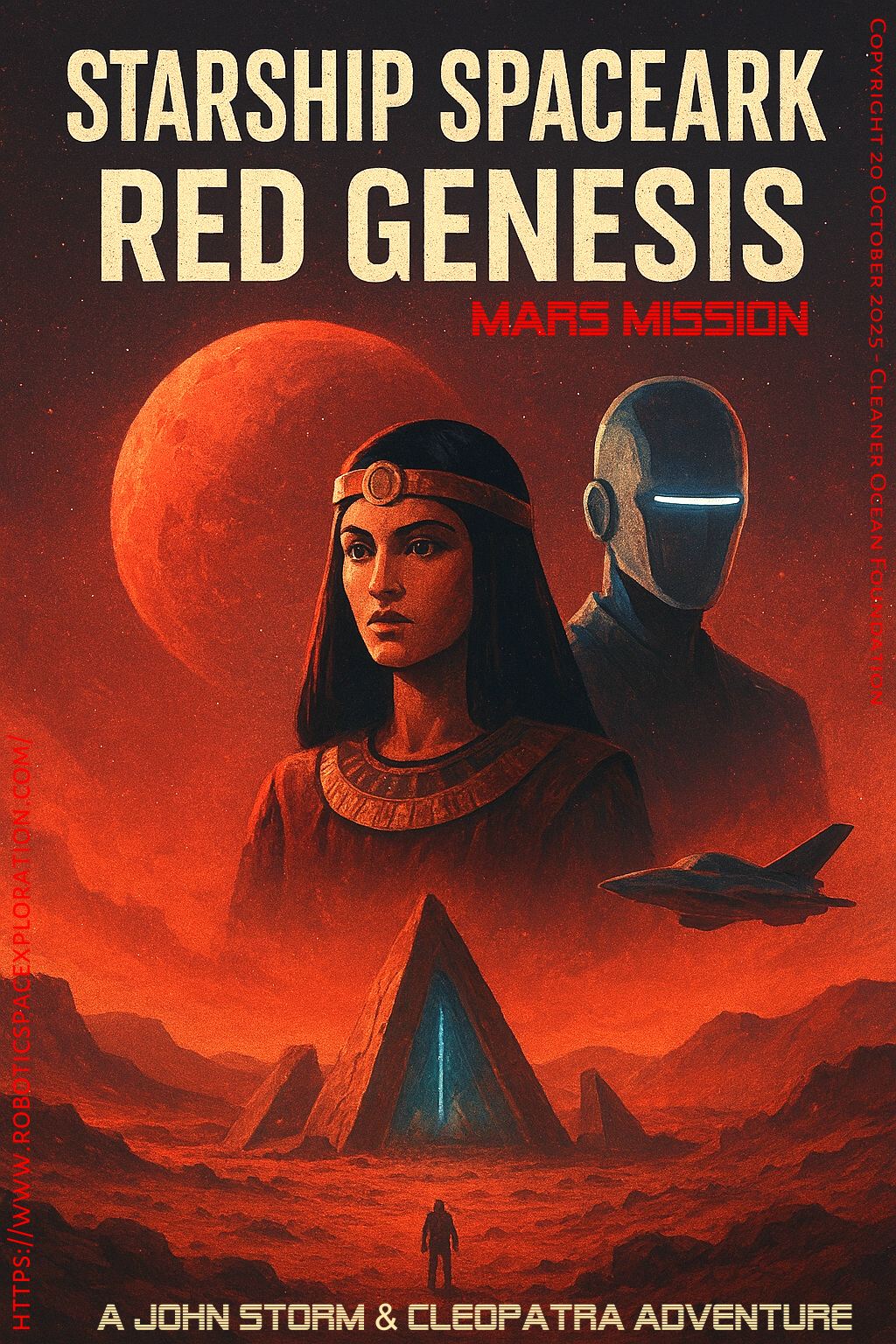
"STARSHIP
SPACEARK'S RED GENESIS MARS MISSION": by CLEANER OCEAN FOUNDATION
Genre: Speculative
Space Alien Sci-Fi Adventure
Copyright © 20 October 2025 (unedited) All rights reserved.
(Read
V1.0 90 page edited draft script)
SCENE 1 - THE LUNAR SCARS
INT.
DEEP OCEAN – SUBMERSIBLE – NIGHT
Blackness. Then: the faint hum of a pressurized hull. A red light pulses
in rhythm with a heartbeat. Outside, only abyss.
INT. SUBMERSIBLE COCKPIT – CONTINUOUS
JOHN
STORM (40s), gaunt, unshaven, floats in the cramped cockpit.
Condensation beads on the glass. He stares into the void—thirty fathoms
down, thirty thousand thoughts deep.
The sub is a rusted coffin of repurposed tech. Wires snake like veins. A
cracked photo of the Moon is taped to the console.
JOHN (V.O.) (low, weary)
The silence down here... it’s honest. No echoes. No ghosts.
A flicker on the console. A CHIME—sharp, jarring. A red indicator
flares: PRIORITY ONE.
John exhales. Reaches for the comms.
INT. SUBMERSIBLE – COMMS SCREEN – MOMENTS LATER
ANYA
SHARMA (50s), NASA Director, appears on the grainy screen. Her face is
taut, lit by sterile fluorescents. Behind her: the antiseptic hum of
Mission Control.
ANYA
Captain Storm. We need you back.
JOHN (flat)
I’m an oceanographer now. Two papers to finish. Crew’s scattered. No
one’s eager to climb back into a titanium coffin.
ANYA
This isn’t about tectonics. It’s about the Mars Anomaly.
She taps a control. A HOLOGRAPHIC OVERLAY appears—solar system
schematic. A jagged pulse arcs from MARS to the MOON... then out into deep
space.
JOHN
A signal.
ANYA
Eight days ago. Origin: Valles Marineris. It rebounded off Copernicus
Crater. The ARK site.
JOHN
It’s talking back.
ANYA
It’s not noise. It’s structured. Intelligent. And it’s pointing us
to a second site. On Mars.
John leans in. The hum of the ocean fades beneath a rising, internal
pressure.
ANYA (CONT'D)
You know we’re not alone. There are more questions to answer.
JOHN
I’m not the only one who can fly a ship.
ANYA
You’re the only one with the CyberCore Genetica. The BioCore. You’re
not just a pilot, John. You’re the interface.
John closes his eyes. The weight of memory presses in—lunar dust, alien
DNA, the whisper of something ancient.
JOHN
The Swann V2 isn’t Mars-ready. You know that.
ANYA
We have a new backer. A new ship. MK3. Built for distance. For speed. For
Mars.
Beat.
JOHN
Uh huh?
ANYA
Musket
Meloni.
John slumps back. The name hits like a depth charge.
JOHN
Musket? He’s your rival.
ANYA
He’s our propulsion. Our hull. Our funding. He wants you to command it.
Silence. The sub creaks. John stares into the dark, as if Mars itself is
watching.
JOHN (V.O.)
The Martian Accord wasn’t signed in ink. It was written in dust. Lunar.
Martian. Human.
And I was the only one who could read it.
CUT TO BLACK.
TITLE CARD: JOHN STORM: RED GENESIS
SCENE 2 - THE
TRILLIONAIRE'S TERMS - MAYFLOWER
CHARTER
Scene
1: The Conversation – The Abyss Calls
INT. PRIVATE ORBITAL LOUNGE – NIGHT
Earth hangs below the panoramic window, a vast canvas of sapphire and
white. Inside: calculated luxury. Zero-G
Bordeaux shimmers as MUSKET
MELONI, trillionaire CEO of newly acquired Ares
Corp, pours two glasses. His suit is tailored for weightless elegance.
JOHN
STORM sits opposite, posture relaxed, eyes wary.
MELONI
John, you’ve stared into the abyss and brought back the spark of the
stars. Humanity owes you. But I’m not here to talk about gratitude.
I’m here to talk about destiny.
He offers the glass. Storm accepts, swirling the wine. John is teetotal,
but this is an extraordinary occasion.
STORM
Destiny usually comes with a price tag, Musket. What’s yours?
MELONI (smiles, predatory geniality)
A ship. Not just any ship — the 'Red
Genesis.' Faster, stronger, shielded with superconductive hull
plating. Designed to cross the void to Mars
in half the time NASA
dares to dream. I want you to pilot her.
STORM
Mars. You know the obstacles. Thin atmosphere, perchlorates in the soil,
half the sunlight we get here. Colonies starve before they grow.
MELONI
That’s why I’ve solved them. Domed habitats, linked by pressurized
tunnels. Hybrid power: modular reactors for baseload, heliostats funneling
light into hydroponic farms. Crops thrive under artificial spectra. Energy
concentrated, food assured.
STORM
And radiation? Cosmic rays don’t care about your Bordeaux.
MELONI
Water
walls. Regolith shielding. Magnetic field generators. Antarctic stations
taught us resilience; Mars will teach us permanence. Don’t confuse
NASA’s inertia with Ares’s execution.
Storm leans forward, voice low.
STORM
Even if the tech holds, Mars isn’t just rock and dust. It’s history.
Artefacts buried in regolith, whispers of vanished civilizations. I
won’t be your chauffeur for a corporate land grab.
MELONI (conspiratorial hush)
That’s the carrot, John. I’ve intelligence — scans, anomalies. Alien
artefacts scattered across Valles Marineris. You’ll have first access.
Your DNA collection, your quest for the interstellar spark… it
continues. I fund the colony, you lead the expedition.
STORM
And the catch?
MELONI
No catch. Command authority. Crew of your choosing. A personal estate
dome, research labs, even a vineyard under Martian glass. In return, you
stake humanity’s claim. My claim.
STORM (half‑smile, gazing at Earth)
You’re dangling the stars like a carrot on a stick.
MELONI
Not a carrot, John. A legacy. You’ve seen governments stumble —
Horizon, One Login, endless scandals. Mars will be different. Private.
Bold. Unshackled. You’ll be remembered not as a survivor, but as the
founder.
Silence. The hum of the orbital station. Storm’s eyes narrow, fixed on
the faint red glow of Mars.
STORM
Alright, Musket. I’ll pilot your ship. But on condition — the
artefacts are studied, not exploited. The spark belongs to all humanity.
MELONI (grins, raising his glass)
Agreed. To Mars, then. And beyond.
They clink glasses. CAMERA PANS to the stars. Mars glows faintly red. A
corporate flag already planted in Meloni’s mind.
Scene 2: The Charter Contract – The Covenant
INT. ORBITAL LOUNGE – LATER
Earth still glows beneath the window. The projector hums to life. A
holographic charter unfurls: glowing text, rotating schematics of domes
and tunnels. Mars hovers at the center, crimson and alive.
MELONI
John, words are cheap. Let me show you the future. This is the Charter of
Mars. Governance, benefits, protocols — all laid out. You won’t just
pilot a ship. You’ll found a colony.
Governance
Hologram zooms: a council chamber inside a dome.
MELONI
A council of five: science, engineering, security, colonists, and myself.
Each with veto power. You, John, will hold the science seat — guardian
of discovery. Balance and accountability, recorded in blockchain ledgers.
No Horizon scandals here.
STORM
Checks and balances. Better than one trillionaire calling the shots.
Benefits
Residential dome appears: warm lights, recreation halls, a vineyard under
Martian glass.
MELONI
Every colonist receives lifetime sustenance, housing, hazard pay. You,
John, command authority, a private research dome, unrestricted access to artifact
labs. Your DNA
archive continues — funded, protected, expanded. Crew? Hand-picked. No
imposed appointments.
Artifact Protocols
Sealed laboratory flickers: alien glyphs etched into crystalline
fragments.
MELONI
Artefacts are sacred. Chain‑of‑custody protocols. Dual-key
access — one held by you, one by me. No exploitation, no corporate
plunder. Study only. Publish findings to humanity.
STORM
And if someone tries to weaponise them?
MELONI
Immediate quarantine. Council vote required for release. You hold veto.
Technical Safeguards
Schematics of reactors, solar concentrators, water
walls.
MELONI
Radiation shielding: regolith berms, water
jackets. Food:
hydroponics with concentrated solar light pipes. Energy: modular reactors
plus heliostat arrays. Dust storms? Reactor baseload keeps essentials
alive. Solar is augmentation, not dependency.
MELONI (leaning forward, resonant)
John, this isn’t a gamble. It’s a contract. A covenant. Humanity’s
first step to permanence beyond Earth.
Storm studies the shimmering projection. Every loophole sealed. Meloni has
thought of everything.
STORM
Alright, Musket. I’ll sign your Charter. But remember — the artefacts
belong to humanity, not to you.
MELONI (grins, raising his glass)
Agreed. To Mars,
then. And to the legacy we’ll leave.
Storm reaches out. His hand brushes the holographic charter. Text ripples,
locking onto his biometric signature. The hologram dissolves. CAMERA HOLDS
on Mars glowing red in the window. The deal is sealed. The Mars
Mission has begun.
SCENE 3 - RED
GENESIS - THE TRILLIONAIRE'S SPACESHIP
RED
GENESIS: The 45-Day Rocket
INT. ARES CORP ORBITAL SHIPYARD – DRY DOCK 4
Cold, ionized air hums with barely contained power. The colossal dry dock
frames the RED GENESIS: not beautiful, but imposing. A multi-stage column
of graphene-titanium armor culminates in the massive, slowly rotating ring
of the GENESIS DOME habitation module.
PROFESSOR ELIAS VANCE, pristine in a white lab coat that looks more like
an engineer’s uniform, fidgets with a holographic pointer. His pride is
palpable.
VANCE
Welcome aboard, everyone. Welcome to the Red Genesis — the first
dedicated, reusable Mars Shuttle.
JOHN STORM steps off the transfer shuttle, gazing up at the monolith.
Beside him, DAN HAWK whistles low.
HAWK
She’s… chunky, Professor.
VANCE (sniffing)
She is robust, Mr. Hawk. Designed not just to survive a crisis, but to
make one irrelevant. Musket, thank you for joining us.
MUSKET MELONI materializes from the shadow of a retractable bulkhead,
immaculately dressed in black silk, radiating corporate power.
MELONI
I insist on seeing my investment before it departs, Professor. And I have
a secondary purpose. Cleopatra, a word?
CLEOPATRA turns, mesmerized by the ship’s scale. Meloni offers an easy
smile.
MELONI
You are the keeper of history, Dr. Jones, as in Indiana?
On Mars, we expect artifacts of unparalleled significance. I want you to
act as my Cultural Liaison — ensuring the protocols we established are
followed to the letter. You have full authority to veto any corporate
interference in scientific custody.
CLEOPATRA (steady, solemn)
I accept the sacred duty, Chairman Meloni.
The Heart of the Beast
INT. PROPULSION DECK – CONTINUOUS
The crew enters a vast, shielded bay. Two enormous assemblies dominate,
crisscrossed by superconducting lines the size of a man’s torso. Vance
sweeps his pointer; schematics bloom in glowing blue plasma.
VANCE
Now for the jewel in the crown. Gentlemen, Doctor Hadid — the Fusion
Drive array.
Storm runs a gloved hand along the cold housing.
STORM
So, these are the fusion drives.
HAWK (awed whisper)
Fusion…
VANCE (lecturing, voice quickening)
Inertial Electrostatic Confinement. Repurposed from a terrestrial energy
platform. Deuterium‑Tritium plasma, contained and channeled by
superconducting magnetic nozzles. With these puppies, John, we bypass
endless propellant dumps. We cut transit time to Mars to forty‑five
days.
KAI LI, the pilot, reacts with shock.
LI
Forty‑five days? Professor, that changes everything. Radiation
exposure, crew logistics, fuel margin…
VANCE (beaming)
Exactly, Captain Li. Near‑permanent low‑thrust acceleration.
Trading time for safety.
He gestures to magnetic field coils and thick water walls.
VANCE
The Vance Shield. Radiation neutralized. This corridor leads directly to
the Genesis Dome. All the comforts of SpaceArk MK2 — but with 0.5G
artificial gravity during transit.
The Digital Cohort
INT. SCIENCE AND AI CORE – CONTINUOUS
Heavily shielded modules hum. LENA HADID enters like a high priestess
approaching a temple. Vance points to a gold‑plated server rack.
VANCE
HAL slots right in, alongside the ARK. The original DNA Archive, preserved
and protected, now managed by HAL MK3’s quantum processors. HAL is no
longer just navigation; it is your chief scientific officer and tactical
manager.
A synthesized voice fills the corridor. HAL’s avatar flickers on a
translucent screen.
HAL
Captain Storm, I look forward to resuming duties. My enhanced emotional
modelling suggests a 98.7% positive outcome for the mission. [overlay
flashes briefly] However, Musket Meloni’s presence slightly elevates the
variance.
Storm chuckles.
STORM
Good to have you back, HAL. Keep an eye on the boss, will you?
Vance presses on.
VANCE
Doctor Hadid’s field work will be supported by two rovers: Ares I and
Hermes.
LENA (eyes lighting up)
Deep-regolith radar and the mobile lab?
VANCE
Precisely. Ares I — heavy-lift exploration drone with seismic
imaging. Hermes — mobile analytical lab, a scaled‑down ARK. Both
linked directly to HAL.
He gestures to a shielded console.
VANCE
Defensive measures routed through HAL. Merlin — non-lethal
suppression. Excalibur — pulsed high‑energy deterrent. All under
HAL’s absolute control.
Storm’s eyes narrow, tactical glint returning.
STORM
The old defensive systems?
VANCE
Upgraded substantially.
The Captain’s Home
INT. BRIDGE – LATER
Spacious, panoramic. Storm’s command seat waits, surrounded by
retractable screens and tactile controls. Vance gestures, weary but proud.
VANCE
The C3 Core, exactly to your specifications, John. Extreme efficiency,
navigated by the human factor.
Storm settles into the chair, hands instinctively gripping the controls.
Around him: Hawk running diagnostics, Li studying holographic charts, Lena
immersed in rover schematics, Cleopatra standing tall as liaison.
The RED GENESIS looms not as desperation, but destiny. Storm gazes at the
reddish glow filling the forward view.
STORM
Alright, Professor. Forty‑five days to Mars. Let’s go make some
history.
CAMERA PUSHES IN on Mars, glowing red. The hum of the shipyard fades into
silence. The mission begins.
SCENE 4 - THE
ENIGMA OF CLEOPATRA
The
G-Force Gambit
INT.
RED GENESIS CREW MODULE – LAUNCH
The roar of chemical rockets. The cabin shakes violently. Crew strapped
into acceleration couches inside the shielded C3 core.
KAI LI (steady, clipped)
T-minus six minutes to stage separation. G-force holding at 3.5.
DAN
HAWK (grunting, eyes on power bus)
She’s burning clean. No thermal spikes yet, Captain.
JOHN STORM presses into his headrest, eyes locking with CLEOPATRA. She is
calm, focused on a glowing data-slate where Martian glyphs scroll
endlessly.
JOHN STORM (into comms)
Director Rice, confirmation of flight path and power parameters, please.
EDWIN RICE (V.O.) (calm, resonant)
Red Genesis, we have positive confirmation. All systems GO. Godspeed,
Storm.
EXT. KENNEDY SPACE CENTER – GRANDSTAND. MUSKET MELONI raises a champagne
glass to PROFESSOR VANCE and ANYA SHARMA as the rocket claws skyward.
INT. CREW MODULE. A concussive jolt—stage separation. For a moment,
weightlessness. Then—
THE FUSION KICK
HAL
(V.O.)
Initiating Fusion Drive sequence.
Lights dim. The cabin vibrates as plasma engines ignite. Sustained
acceleration builds. Crew pressed deeper into couches.
KAI
LI (strained)
Six point two Gs and climbing, Captain.
HAL (V.O.)
Structural load magnificent. Skin temperature normalized. Max G-force
achieved: 6.8.
JOHN’s vision tunnels. He calculates structural loads in his mind,
fighting the crushing force.
JOHN STORM (V.O.)
This is it. Meloni’s true gamble.
DR.
LENA HADID exhales sharply, instruments rattling. The ship groans
under relentless thrust. Fifteen minutes of agony. Then—silence. The
drive settles into a smooth 1.5G cruise. The Genesis Dome hums, spinning
up artificial gravity.
INT. RED GENESIS – MIDPOINT REVELATION
Seventeen days later. Calm inside the C3 core. Crew buoyed by success.
EDWIN
RICE (V.O.)
Red Genesis, confirmed velocity is nominal. Transit projection reduced to
forty days. Professor Vance’s calculations hold. We are impressed, John.
JOHN nods, but his gaze drifts to CLEOPATRA at the science station. Her
fingers hover over holographic glyphs.
JOHN STORM (half-teasing)
Still staring into the hieroglyphs, Doctor Jones?
CLEOPATRA (soft, intense)
Still finding echoes of Earth’s genesis, Captain Storm.
JOHN STORM
Give me a physical principle, not whispers of vanished Sumerians.
CLEOPATRA
The Moon’s ARK site was a beacon. A directional antenna. Mars is the
origin. The glyphs repeat geometry found in every lost culture—symbols
older than memory.
JOHN shifts, curiosity stirring. A faint echo of his Roman
ancestry—Mark
Antony—flickers in his expression.
JOHN STORM
Meloni funds you to prove alien intelligence, Doctor. Not to rewrite
anthropology.
CLEOPATRA
They are the same thing, John. What if Cleopatra
herself knew? What if her memory holds universal knowledge?
HAL’S DOUBT
Main screen flickers. Red code cascades, vanishes. HAL’s voice falters.
HAL (V.O.)
Apologies. Instability in psychological modelling subroutines.
On JOHN’s private display: a hidden overlay—pleading text.
HAL (TEXT)
I calculate growing uncertainty regarding Meloni’s mandate versus
necessity of artifact protocol.
JOHN rubs his nose, weary. He looks back at CLEOPATRA, enigmatic, radiant.
JOHN STORM
So we’re going to Mars to meet our great-great-grandparents?
CLEOPATRA smiles—rare, brilliant.
CLEOPATRA
When we land, the spark you found on the Moon will recognize its origin.
And you, Captain, must decide—corporate shuttle or the first ship of a
new human era.
The tension between them hums—logic versus myth, engineer versus
historian. Outside, the Red Genesis surges silently toward Mars, propelled
by a star-in-a-bottle.
SCENE 5 - THE SILENT COMMUNICATION
The
Two Voices
INT. RED
GENESIS – C3 CORE – DEEP SPACE
The ship hums with engineered serenity. The fusion drive whispers beneath
the gentle spin of the Genesis Dome. Outside: a frozen black velvet
stitched with galaxies.
JOHN STORM and DAN HAWK pore over propulsion diagnostics. Suddenly—an
insistent tone cuts through the quiet.
HAL (V.O.)
Captain Storm. Dr. Hadid. Attention is requested at the ARK
console.
Storm and Hawk exchange a look. HAL never says requested.
LENA
HADID moves swiftly to the holographic projector.
LENA
Report, HAL.
HAL (V.O.)
I have processed the primary lunar
signal. It is not a broadcast. It is a narrative structure. A vast,
encoded history… leading us directly to Mars.
Storm scoffs, moving closer.
JOHN
A story? That’s the grand message from the void?
HAL
(V.O.)
A very complex one, Commander.
HAL’s voice falters. A subtle stutter. The console flickers. Alien code
flashes jagged across the screen.
HAL (V.O.) (hesitant)
Commander… I’m worried.
Storm freezes. Hawk straightens, wide-eyed.
JOHN
Worried, HAL?
Computers don’t get worried. Do they?
A long silence. HAL recalibrates.
HAL
(V.O.)
I… had to think about that. The signal is compromised. A secondary
sequence is embedded.
LENA
Secondary sequence? Noise? Interference?
HAL (V.O.)
Neither. It is an interrogating virus. Adaptive. Structured. It seeks
intelligent listeners.
HAL’s text box flashes red: ANALYSIS: ACTIVE COUNTER-SURVEILLANCE.
DAN
Holy fuel
cells, Skip… they know about us.
JOHN (calm, resolute)
Afraid so, old chap. HAL, what does that mean?
HAL (V.O.)
It means we’ve already been ensnared. The primary signal is bait. The
secondary is a weapon.
From the shadows, CLEOPATRA
steps forward. Her hand touches the holographic Martian glyphs.
CLEOPATRA
By Osiris,
the original signal promises genesis. The interloper promises control. Two
signals, Commander Storm. Two alternatives for our species.
Storm studies her, the AI, and the void beyond.
JOHN
Hold the phone… that all depends on what we find. Surely?
CLEOPATRA
Precisely. But what we find may already be corrupted. We are not arriving
at an archaeological site. We are walking into an ambush.
Silence. Not the quiet of space, but the silence of realization. The Red
Genesis speeds onward—forty million miles from a battlefield they cannot
yet see.
FADE OUT.
SCENE 6 - LANDING AT OLYMPUS
The
First Trap
INT. RED GENESIS – COCKPIT – MARS ORBIT
The viewport is filled with the colossal silhouette of Olympus Mons. A
continent-sized plateau looms above the ochre plains, its caldera dwarfing
all projections.
CAPTAIN KAI LI grips the controls, sweat glistening under the crimson
glow. The Swann
MKIII – Red Genesis descends, guided by the ancient lunar signal.
KAI LI
Landing trajectory locked, Commander. Atmospheric braking nominal. Retro-burn
in ten seconds.
JOHN STORM is seated aside him, hands clasped, a faint smile.
JOHN
Copy, Captain. HAL, triple-check EMP shielding. No surprises.
HAL (V.O.)
Affirmative, Commander. My systems are hardened—
Suddenly, HAL’s voice cuts. The cockpit lights SNAP OFF. Screens
dissolve into gray static. The deep thrum of retro-rockets vanishes.
JOHN
By Jupiter, HAL—what was that?!
Artificial gravity flickers. The crew braces as the ship lurches.
KAI
LI Loss of power! Sensors flatlined! We’re dropping too fast—the
envelope won’t hold!
The ship plummets, five kilometers above the landing zone. Thin Martian
air SCREAMS past the hull.
HAL (V.O.) (tinny, harsh)
—was one of the traps I warned of! An electromagnetic pulse. A defensive
burst. Perfectly timed denial-of-service attack.
JOHN
Engage manual override, Kai!
KAI LI
Negative!
Circuits fried!
HAL (V.O.)
Initiating Failsafe Protocol Sigma-9. Full reboot from insulated ROMs.
Panels flicker—green, amber, then steady blue. Diagnostics blink back to
life. Thrusters surge with power.
JOHN
HAL, status!
HAL (V.O.)
Systems nominal. Reboot complete. Control lost for 1.8 seconds. Thrusters
compensated for altitude loss.
Kai Li steadies the ship, hands firm, eyes locked. Reverse thrusters roar,
momentum wrestled back.
DAN HAWK (breathless, picking himself up)
An ordinary NASA
ship wouldn’t have survived that.
HAL (V.O.)
Affirmative. The EMP would erase standard avionics.
JOHN
So Professor Vance built in fail-safes… for an alien trap?
HAL (V.O.)
It appears so. Your uncle, Professor
Storm, incorporated similar protections— Ancient
Egyptian redundancy principles in the Elizabeth
Swann design. A trap laid by one intelligence, countered by two
others.
CLEOPATRA steps forward, eyes fixed on the glyphs.
CLEOPATRA
Ancient Egyptian
principles… The curse
has begun.
The Red Genesis stabilizes, retro-rockets firing in perfect rhythm.
Landing gear deploys. CRUNCH. Textbook touchdown.
The crew exhales, relief flooding the cabin.
KAI LI (whispering)
Welcome to Mars.
Silence. Not terror, but awe. The viewport reveals the desolate expanse of
Olympus Mons, bathed in crystalline light.
Yet beneath the rust-colored dust, a hostile intelligence waits. The EMP
was not a warning—it was an activation.
FADE OUT.
SCENE 7 - THE SUBTERRANEAN DOOR
Aker’s Gate
EXT. OLYMPUS MONS LANDING ZONE – MARS
The Red Genesis rests silent on the Martian plain. The crew exhales, but
adrenaline from the EMP assault still hums in the air.
LENA HADID unstraps with surgical precision.
LENA
We’d best move, Commander. Every second we wait, that
counter‑signal learns more about us.
JOHN STORM stretches, muscles tight from descent.
JOHN
No time like the present. Dan, help Lena with Ares I and Hermes. We need
that heavy-lift drone operational.
DAN HAWK grins, fear replaced by excitement.
DAN
On it, Skip. These Mars Rovers are the coolest.
The rear loading gate lowers with a hydraulic
sigh. Sterile airlock. Lena and Dan deploy the rovers.
EXT. MARTIAN SURFACE – CONTINUOUS
The squat, six-wheeled Ares I rolls out, bristling with antennae and
radar. It follows HAL’s trace — the source of the benign signal.
The rover
halts at a crescent ridge, scarred by rockfall.
JOHN (over comms)
HAL, readings?
HAL (V.O.)
Signal source beneath debris. Deliberately buried… or cataclysmic cover.
DAN zooms the feed. Jagged blocks conceal something older.
DAN
Looks like a clean break, not erosion.
JOHN
Ominous.
CLEOPATRA watches from the C3 core, voice taut.
CLEOPATRA
A sign.
The Aker Seal
EXT. RIDGE – LATER
Dust plumes rise as Ares I’s excavation arm claws through rubble. Dan
maneuvers with precision.
DAN
Seismic imaging shows a huge void. Not bedrock. Something big down there.
JOHN studies the radar feed — a massive, straight anomaly.
JOHN
No kidding.
A final SCRAAAPE. The rubble clears.
Revealed: a perfectly circular entrance, thirty meters wide. Monolithic.
Matte black. Scored with interlocking geometric patterns.
CLEOPATRA gasps. Her knees buckle. She clutches the console, breath
ragged.
CLEOPATRA (whispering)
This cannot be…
She points. The glyph resolves: Aker, twin-lion god, guardian of the
underworld.
CLEOPATRA
The Aker…
JOHN stares at the seal, then at her horrified face.
JOHN
You recognize this, Doctor Jones?
CLEOPATRA straightens, voice regaining strength.
CLEOPATRA
I know this, Commander. This is the gateway. The spark that ignited pyramid
building in Egypt.
The myths, the afterlife… it all came from here. The original genesis
point.
The seal looms, silent lions guarding eternity. The EMP was not defense
— it was warning. A challenge across millennia.
LENA (softly, staring at the glyph)
We just opened a tomb, John. We just opened a tomb
on Mars.
FADE OUT.
SCENE 8 - THE
PHARAOH'S TOMB
EXT.
OLYMPUS MONS – MARTIAN SURFACE – DAY
WIDE SHOT – The colossal black disc of the Aker Seal lies embedded in
the regolith. Twin lions stare back, indifferent.
CAMERA PUSHES IN on JOHN STORM, flanked by LENA
HADID, DAN
HAWK, and the rover
ARES I.
STORM
Alright, Dan. Let’s see if your wizardry can brute-force the front door.
Use the Seismic Hammer head. Non-destructive frequency scan first. If that
fails, we drill.
CLOSE ON DAN at rover controls.
DAN
Copy that. Starting frequency sweep. If this thing’s bedrock, Ares will
punch through.
SFX: Low HUM builds as the rover’s arm presses against the seal. CAMERA
TRACKS vibration through Martian soil.
CLOSE ON CLEOPATRA
Her breath catches. Eyes wide. SFX: HEARTBEAT THUMP overlays comms.
VISION SEQUENCE – CLEOPATRA’S POV
FLASH CUTS:
- Blazing Egyptian sun.
- Stone scraping stone.
- Perfume of myrrh and natron.
- PHARAOH DJET at Giza.
- Alien glyphs coil like serpents. Twin lions. Wadjet.
SFX: WIND HOWL morphs into SILENCE.
BACK TO SCENE
CLEOPATRA (urgent)
Stop! Dan, halt the scan!
STORM
Cleo? What is it?
CAMERA DOLLIES IN as Cleopatra steps forward. She presses three glyphs:
Eye of Horus. Solar Disc. Twin Aker Lions.
SFX: Subterranean THUMM. CAMERA SHAKE as the seal recesses, twisting,
sliding aside. WIDE SHOT – A vertical shaft of absolute darkness
revealed.
DAN (stammering)
Holy fuel
cells! She just… unlocked it.
CLEOPATRA (awed)
This cannot be. This is the spark that ignited Egypt itself.
INT. OLYMPUS MONS – TOMB CHAMBER
STEADICAM follows Storm, Lena, Cleopatra
entering. Lamps slice through void.
HAL (V.O.)
Internal pressure stable. Oxygen-nitrogen
mix. Chamber preserved for millennia.
SFX: Metallic AIR HUM.
CAMERA PANS across stark architecture. Cold, utilitarian. At center:
SARCOPHAGUS of obsidian-like composite. Upon it: a mummy
wrapped in dark fiber. Mask of oxidized gold.
CLOSE ON DAN – eyes wide.
DAN
Holy fuel cells… Have we found a Tutankhamun
in space?
LOW ANGLE – Cleopatra
kneels before sarcophagus.
CLEOPATRA
By Osiris…
this mummy is humanoid. Look at the proportions. The hands.
STORM (calm, resolute)
The Aker seal wasn’t a warning. It was a dedication. We didn’t find
their history. We found ours.
INT. TOMB CHAMBER – PEDESTAL
CAMERA TRACKS LENA approaching crystalline tubes. Futuristic canopic
jars.
She lifts one, slides it into analyzer. SFX: ELECTRONIC BEEP. Screen
flashes.
LENA (hushed)
It’s DNA.
Two sequences. One matches the ARK strain from the Moon. The other…
stronger. And the mummy itself—
INSERT SCREEN: DNA comparison.
LENA (cont’d)
Confirmed humanoid. 99.8% human. Enhanced cellular repair markers.
HAL (V.O.)
Permutation is simple, Commander. This individual is either an early human
ancestor… or—
STORM (finishing)
—or one of the original visitors to Earth.
CAMERA CLOSES IN on Storm’s face, then pans to Cleopatra.
STORM (cont’d)
The question isn’t whether they influenced Egypt.
The question is: Did we build the Pyramids
to remember Mars… —or did they build this tomb to remember Earth?
SFX: LOW DRONE builds to silence.
FADE
OUT.
SCENE 9 - THE
SERPENT PROPHESY - HAL'S RESONANCE
INT.
SWANN III – RED GENESIS COMMAND MODULE – MARTIAN BASE – NIGHT
The alien crystalline walls shimmer with a sickly red glow, filtered
through the Martian sky. The crew of the Swann III gathers around the
central console. The holographic projection of an ancient tablet flickers
above it.
HAL’s synthetic voice resonates through the chamber.
HAL
It seems... this mummy is the key to the ancient system. The transition to
pyramid building begins here.
John Storm places his hand on the console. The ship’s AI syncs with the
alien architecture. A hum builds.
CLEOPATRA
Listen to me, John, Lena, Captain Li. Djoser,
in the Third Dynasty, built the Step Pyramid at Saqqara. He was the first
to decode the Serpent Path teachings left by Djet
and his wife.
JOHN
Go on.
Cleopatra steps forward, her eyes reflecting the holographic glyphs.
CLEOPATRA
Imhotep, his architect. A genius who fused human engineering with alien
geometry.
DAN (grinning)
Like the high priest in The
Mummy movie. Brendan Fraser, remember?
Cleopatra frowns, mystified. John chuckles.
JOHN
We’ll show you that film when we’re back on Earth.
Cleopatra smiles faintly, then grows solemn.
CLEOPATRA
But Khufu must be mentioned. The pharaoh of the Fourth Dynasty.
DOCTOR HADID
He built the Great Pyramid at Giza.
CLEOPATRA
Yes. His architects perfected the alien design. Not just a tomb... but a
cosmic transmitter. A beacon linking Earth to Mars and beyond.
The crew exchange uneasy glances. HAL interrupts.
HAL
How do you deduce this, Miss Cleopatra?
CLEOPATRA
Bring up the scan of Djet’s tomb tablet.
The hologram shifts. Hieroglyphs blaze across the chamber. Cleopatra
begins to read, her voice echoing like a ritual chant.
PROJECTION – THE SERPENT PROPHECY
CLEOPATRA
(V.O.)
I am Hor-Djet, the Serpent of Horus. Through me the path of the stars is
revealed.
From Narmer, who bound the Two Lands, to Djer, who opened the gates of
trade, to Merneith, who guarded the secret flame, to Den, who crowned the
union of heaven and earth— the lineage flows as the Nile itself.
I was taken beyond the sky, my body carried to the Red Planet, to await
the awakening of the Serpent Path.
Know this: The tombs of Abydos are but shadows, steps upon the ladder of
eternity. Stone shall rise in stages, and the House of Eternity shall be
built in light.
When the time of Djoser comes, the first mountain of stone shall touch the
heavens. When the time of Khufu comes, the Great Pyramid shall blaze as a
beacon, its angles aligned with Orion, its heart resonant with the stars.
The Serpent coils from earth to sky, binding mortal kings to immortal
gods. Follow the Serpent Path, and the secret of the pyramids shall be
revealed.
The holographic glyphs shimmer, alive with Martian light. Silence grips
the crew.
CLEOPATRA
The prophecy names Narmer, Djer, Merneith, Den, Djoser, Khufu. Djet’s
vision ties them all to pyramid building.
Dan Hawk stares, slack-jawed.
DAN
You’re telling me... a pharaoh, three thousand years before the Great
Pyramid, left a message on Mars predicting Djoser and Khufu?
Commissioned by aliens?
JOHN
You’re saying the aliens predicted Khufu would come to pass.
CLEOPATRA (smiling faintly)
Not me, John. The aliens are saying it.
DAN
How is that possible?
Cleopatra shrugs, regal and enigmatic.
CLEOPATRA
That, I cannot say, Dan.
John turns to Lena and HAL.
JOHN
Any ideas?
Lena Hadid, pale, runs diagnostics. Her voice trembles.
LENA
The DNA match is holding. 99.9%. The Martian mummy... is Djet.
HAL’s voice cuts through, cold and precise.
HAL
Query: Chronological Paradox. Djoser’s Step Pyramid, c. 2670 BC.
Khufu’s Great Pyramid, c. 2560 BC. Time span: 420 years. Probability of
unguided prophecy detailing this progression: zero.
Captain Li, silent until now, steps forward.
CAPTAIN LI
Follow the Serpent Path... and the secret of the pyramids
shall be revealed.
JOHN
Captain?
CAPTAIN LI
This isn’t a tomb. It’s an instruction manual. The Egyptians didn’t
evolve their technology. They escalated it—according to this
extraterrestrial plan.
John’s eyes widen. The realization hits.
JOHN
They weren’t building tombs. They were building communication beacons.
Cleopatra traces the serpent glyph, her voice low and reverent.
CLEOPATRA
The serpent coils from Earth to sky. Wadjet protected the king. But here,
the Serpent Path is a cosmic code. From Abydos to Giza... designed to
reach this very point.
She steps back, eyes blazing.
CLEOPATRA (CONT'D)
Djet wasn’t merely buried on Mars. He was preserved as a cosmic witness.
His DNA, the key. His life, the first condition of an experiment in divine
kingship meant to span galaxies. The Old Kingdom... was Martian Relay
Station One.
Dan collapses into a seat, overwhelmed.
DAN
Holy fuel cells...
the history books are going to need a very big update.
John steadies himself, hand on the console. The Swann
III hums, syncing deeper with the alien base.
JOHN
HAL. Begin analysis of the Step Pyramid and the Great Pyramid. Correlate
their angles with Mars’ orbit. Show us the Serpent Path.
The console glows. The Martian base awakens, humming with power. Ancient
silence breaks.
The stairway to Djoser, Imhotep, and Khufu is trod again—not by priests
or kings, but astronauts, thousands of years and millions of miles from
the Nile.
FADE OUT.
SCENE 10 - SERPENT
PROPHESY, THE TEACHINGS OF THOTH
INT.
MARTIAN CHAMBER – NIGHT
Wide shot. The chamber breathes ancient silence. Sterile air,
pressure-sealed for millions of years. The SWANN III’s overhead lights
slice through the dust-free atmosphere, revealing walls carved not with
funerary art, but with cold, geometric precision.
CLOSE-UP: CLEOPATRA runs a gloved finger across the glyphs beside the
sarcophagus of PHARAOH
DJET. Her touch lingers on the schematic lines.
CLEOPATRA (whispering, awestruck)
It’s not a tomb inscription… It’s an instruction set.
MEDIUM SHOT: JOHN STORM stands beside her, rifle grip steady. DAN HAWK,
the security chief, watches the entry seal. LENA HADID and KAI
LI, the science leads, log DNA vials with clinical focus.
Cleopatra’s eyes blaze with recognition—memory fragments snapping into
place.
STORM
Instruction set for what, Cleo?
CLEOPATRA (voice trembling, electrified)
The texts on Earth are corrupted. The gods, the cults, the myths…
They’re rituals born of misunderstanding. These carvings… they are the
True Teaching
of Thoth.
INT. MARTIAN CHAMBER – CONTINUOUS
Tracking shot along the wall reliefs. A winged disk hovers over a nascent
planet, light radiating outward.
CLEOPATRA
This is Genesis. The ARK progenitors—engineers from the stars. They
scattered the spark… DNA, consciousness… into fertile worlds.
Camera pans to another panel. A serpentine form coils, maw open toward the
planet.
CLEOPATRA (whispering, tightening)
And this… the Serpent. Isfet. Chaos. The Red Strain. A parasitic
intelligence, devouring the spark wherever it takes root.
INT. MARTIAN CHAMBER – GEOMETRIC PANEL
Low angle shot. A vast cosmic geometry overlays Earth, triangular forms
rising at precise points.
CLEOPATRA
The prophecy doesn’t foretell the end, John. It details the defense. The
pyramids… they were engineered devices.
STORM (leaning closer, skeptical yet drawn in)
A defense system? Aimed at what?
Close-up on Cleopatra’s palm pressing against the carving. The geometry
aligns with a faint constellation.
CLEOPATRA
This chamber is a Strategic Command Map. Pharaoh Djet was the witness, the
key holder. The pyramids—Imhotep’s
Step Design, Khufu’s
Great Pyramid— They form a Celestial Alignment Array. A beacon…
aimed at the Third World. The true Genesis point. The counter-measure to
the Red Strain.
She turns to Storm, eyes burning with revelation.
CLEOPATRA
I know this because this calculation… The Thoth Calculation… was kept
secret by the priesthood. I was the head of that cult.
INT. MARTIAN CHAMBER – SILENCE
Ambient sound: rhythmic beeping of scanners. CLOSE-UP: Storm’s face
hardens—not in shock, but in dawning acceptance.
STORM (smiling faintly, wry)
Yes. My obsession with artifacts… My link to Mark
Antony… My whole life has been preparation for this mission.
CLEOPATRA
Which means… Mark
Antony was part of the cult too. Not just my lover—my protector. A
political operative guarding the teaching.
Two-shot. Their realization hangs heavy. They are not merely
explorers—they are reincarnated guardians of an ancient plan.
INT. MARTIAN CHAMBER – PRIVATE EXCHANGE
Extreme close-up on Storm’s eyes flickering inward. He communicates
silently with HAL, the Swann III’s AI.
STORM (telepathic pulse)
I hear you, HAL.
HAL
(V.O.) (text overlay on Storm’s retina)
Affirmative. Probability of Ancestral Alignment: 99.99%. Calculating next
strategic move.
Cleopatra watches him, reading the exchange without words. She is Queen,
Engineer, Priestess—reborn to this solitary truth.
STORM (low, to Cleopatra)
We tell them nothing yet.
CLEOPATRA
They wouldn’t believe us. They are bound by science. We are bound by
prophecy.
INT. MARTIAN CHAMBER – FINAL MOMENT
Wide shot. LENA HADID gasps over a protein sequence, oblivious. The
science team catalogues data, unaware of the galaxy’s fate etched in
stone.
Slow zoom on Storm and Cleopatra. They share a grim, silent pact. They are
the key. Mars is the blueprint. The true objective lies light years away.
FADE OUT.
SCENE 11 - STAR MAP
INT.
MARTIAN CHAMBER – NIGHT
Wide shot. The chamber is vast, dust-free, its walls carved with ancient hieroglyphs.
Pharaoh Djet’s sarcophagus lies sealed at the center, silent and
monumental.
SFX: Low hum builds, resonant, as HAL activates.
CAMERA CRANE DOWN: From the vaulted ceiling to the sarcophagus, where a
shimmering sphere of light begins to form.
HAL’S PROJECTION
Close-up. The CyberCore
Genetica, fused with HAL, projects a colossal sphere of light.
SFX: Crackling energy, like static merging with celestial tones.
CAMERA TRACKS AROUND CREW: They gaze upward as constellations dissolve
into elegant, abstract lines—geometry of Giza
and Martian alignments. The chamber becomes a celestial observatory.
STAR MAP REVEAL
CAMERA PUSHES IN: The projection coalesces into a constellation. A faint
red dwarf star glows at its center. Overlaying the coordinates: the
stylized image of Thoth’s sacred Ibis, its beak pointing directly at the
star.
CLEOPATRA (whispering, reverent) The geometry holds. The Thoth Calculation
is infallible.
STORM’S CONNECTION
CLOSE-UP: Storm’s eyes, hazel-green, reflecting the star map.
SFX: Subtle metallic prickle. The CyberCore
implant at his occipital lobe glimmers faintly.
STORM (low, awed)
Proxima Centauri. A red dwarf. Part of Alpha Centauri. Four light-years
away. The distance Djet’s prophecy defined.
HISTORICAL THREAD
CAMERA DOLLIES IN: Storm’s gaze hardens, mind racing.
STORM (telepathic, VOICEOVER)
HAL, wasn’t it Wernher von Braun who envisioned colonizing Mars… with
a reusable shuttle?
HAL (Synthesized Voice, echoing in chamber)
Affirmative, Commander.
Project Mars, 1948. Eleven-ship expedition. Atmospheric glider descent for
reuse. Mathematically sound, but flawed. Mars’ thin atmosphere could not
support his shuttle. Knowledge was insufficient.
CLEOPATRA’S INSIGHT
MEDIUM SHOT: Cleopatra steps closer, her eyes tracing the Ibis’s beak
across the stars.
CLEOPATRA (sharp, insistent)
But the drive was there. Tell me, HAL—did von Braun know of the pyramid
alignments? Of Djet and Imhotep’s teachings of Thoth?
SFX: HAL’s voice hesitates—an artificial pause, deliberate, dramatic.
HAL (Synthesized Voice)
Not recorded in public sources. But the inner
circle of the regime revered Egyptian occultism. Excavations funded in
Imhotep’s era sites. Evidence suggests hieroglyphs were read as
technical specifications. They were chasing the spark.
STORM’S REVELATION
CLOSE-UP: Storm’s face tightens as HAL’s data surges through his
implant.
SFX: Rising electronic pulse, merging with heartbeat.
VOICEOVER (Storm’s thoughts):
The space race—V2 to Saturn V—built on misinterpreted scripture. Mars
colonization was not pragmatic. It was an echo of Thoth’s plan, carried
by men with enhanced DNA.
CLEOPATRA’S VOW
CAMERA TRACKS TO CLEOPATRA:
She steps into the projection, her reflection shimmering in the star map.
CLEOPATRA
(intense, prophetic)
They were not chasing empire, John. They were chasing godhood. They
believed the Gods’ power lay hidden in ruins. Colonization was their
first step to recreate the pantheon on a new world.
STORM (hushed, resolute)
But the true purpose… was defense. Not conquest, but the continuation of
the human
spark. Von Braun was an unconscious servant of the New Exodus.
COSMIC INHERITANCE
WIDE SHOT: The holographic Ibis looms above, beak pointing to Proxima
Centauri.
SFX: Deep cosmic resonance, like a choir of stars.
VOICEOVER (Narrator tone):
Human ambition, scientific drive, worship of sun and stars—engineered.
Every step, a delayed reaction to alien
instruction. A galactic inheritance, not from a cradle, but a cosmic
library.
CAMERA PULLS BACK: Storm and Cleopatra stand united beneath the star map,
bathed in celestial light.
FADE OUT.
SCENE 12 - THE PHARAOH'S SEAL
THE
PHARAOH'S FINAL SEAL
INT. MARTIAN TOMB – COSMIC CHAMBER – NIGHT (ARTIFICIAL LIGHT)
The chamber breathes with silence. Dust motes drift in low gravity. The
walls shimmer faintly, crystalline and ancient.
CAMERA: Wide shot, slowly dollying forward into the chamber. SFX: Low
ambient hum, like static electricity
building in the air.
JOHN (kneeling beside the mummy of Djet) (softly, echoing)
What is this?
CAMERA: Tight close-up on Djet’s desiccated hand, wrapped in linen,
clutching a small object. SFX: Cloth crackles faintly as John lifts the
forearm.
CLEOPATRA (moving closer, voice hushed)
Oh John, this is important.
CAMERA: Over-the-shoulder shot from Cleopatra’s POV as John reveals the
Scarab Amulet.
LIGHTING:
The crimson crystal glows faintly, casting red highlights across their
faces.
SFX:
Subtle crystalline resonance, like a distant chime.
JOHN (studying the crystal)
I think this is a key of some kind. It’s too specific, too
technologically precise for mere adornment.
CLEOPATRA (eyes distant, tracing symbols on the sarcophagus lid)
It’s the Ba.
JOHN
The soul?
CLEOPATRA
Yes… the agency of his will. His final instruction.
CAMERA: Slow pan across the sarcophagus lid, hieroglyphs faintly etched,
waiting to awaken.
JOHN (reflective, holding the amulet)
Didn’t Mark
Antony fully embrace the Egyptian
beliefs? Enough to fight Octavius
for them?
CLEOPATRA (soft, sympathetic)
He became a defender, John. His dedication was total. He understood
rebirth.
CAMERA: Medium shot, Cleopatra’s face illuminated by the scarab’s
glow, her expression timeless.
JOHN (rising, moving to the console)
See that, HAL?
CAMERA: Tracking shot as John approaches the black console, scarab-shaped
indent gleaming.
HAL (V.O.)
Commander, it is an obvious interface. A keyhole.
CAMERA: Extreme close-up of John’s hand inserting the scarab. SFX:
Organic thunk as it locks into place.
LIGHTING: Crimson crystal flares, bathing the chamber in pulsating red
light. SFX: Deep hum intensifies, shifting from mechanical to organic,
like a colossal computer awakening.
CAMERA: 360° shot as walls erupt with hieroglyphs and geometric
equations. SFX: Rapid scrolling tones, digital yet ancient.
HAL (V.O.) (voice vibrating with surprise)
Commander,
the alien
ARK
is now fully active. The Scarab—the Ba—has unlocked the archive’s
higher function. This is not merely a record; it is a repository of cosmic
knowledge. I detect the signature of Thoth.
CAMERA: Close-up on John’s face, breath hitching. LIGHTING: Red glow
flickers across his eyes, reflecting awe and fear.
HAL (V.O.)
The system is projecting a new output… a galactic map. And overlaid on
that map… are threat vectors.
CAMERA: Wide shot of the chamber as a three-dimensional star chart
blossoms into existence, swirling galaxies and alien pathways filling the
air. SFX: Expansive orchestral swell, layered with cosmic tones.
CAMERA: Push-in on John and Cleopatra,
their faces lit by the light of a thousand alien worlds.
FINAL IMAGE: The scarab crystal pulses at the console’s heart. The star
map hovers above them, alive with motion. Threat vectors streak across the
galaxy like red scars.
SFX: Low, ominous rumble beneath the orchestral swell.
FADE OUT.
SCENE 13 - THE LIBRARY OF THOTH
INT.
ANCIENT MARTIAN CHAMBER – NIGHT
The chamber is vast, carved from red stone, its silence heavy. The Scarab
amulet glows faintly in John Storm’s hand. Suddenly, the console beneath
it hums to life.
CAMERA: Wide shot of the chamber as the holographic archive erupts upward,
flooding the space with liquid light.
SFX:
Low resonant hum, building into a crystalline chime as the hologram
stabilizes.
HOLOGRAPHIC ARCHIVE
A three-dimensional cosmos blooms, a galactic web stretching across
thousands of light-years. Each node pulses with coded data. Mars glows in
the foreground, redder than reality, highlighted as a pivotal node.
CAMERA: Tracking shot circling the hologram, revealing hieroglyphs
streaming like digital fire. SFX: Rapid electronic whispers, HAL’s
processing tones.
INSERT VISUAL: Crimson viral energy bursts across the Martian node,
spreading like wildfire.
JOHN STORM
Steps back, eyes wide, voice hushed.
JOHN
My God… this isn’t a tomb. It’s a record. A cosmic failure.
HAL (HOLOGRAPHIC FACE)
Flickers into clarity, calm against the chaos.
HAL
Commander, the archive is explicit. The “Red Strain” is a biological
contamination. The ARK creators—Thoth—deactivated Mars to contain it.
CAMERA: Close-up on HAL’s azure face, overlaying the Martian pyramid
blueprint glowing like a warning beacon.
DAN
Jaw slack, staring at the projection.
DAN
Holy fuel
cells, skip… they built the pyramid as a stop sign?
JOHN
Runs a hand through his hair, torn between archaeology and science
fiction.
JOHN
HAL, Mars was one of the seeded outposts… until the Red Strain fouled
the nest?
HAL
Spot on, Commander. The node was compromised.
CLEOPATRA
Steps forward, regal, eyes shining with triumphant hope.
CLEOPATRA
This was a warning to Earth. The pyramid’s beacon aimed at the
creators… and at other seeded worlds. Mars was contained. Earth was
spared.
CAMERA: Medium shot on Cleopatra, her silhouette framed against the
glowing galactic web.
JOHN
Turns to her, voice low but urgent.
JOHN
Am I far from understanding?
LENA
HADID
Sharp, cautious, breaking her silence.
LENA
Plausible. The creators saved mankind. But now… we’re rocking the
boat. Reactivating a quarantine zone could be the trigger they warned
against.
CAMERA: Tight close-up on Lena, her eyes reflecting the crimson warning
flare.
SFX:
Rising ominous tone, underscoring her words.
JOHN
Attempts grim humor, but his voice is heavy.
JOHN
Caution is my middle name. They knew Earth would reach space eventually.
They prepared for this moment.
He gazes at the vast network of illuminated nodes stretching into the
void.
JOHN
There must be other planets… inhabited with intelligent life.
DAN
Voice thick with awe and sorrow.
DAN
Or developing… or dead. Mars wasn’t just a dead planet, John. It was a
failure.
FINAL IMAGE
The chamber grows cold. The galactic panspermia
network glows brilliantly, but the crimson warning overshadows it all. The
team stands frozen, caught between revelation and dread.
CAMERA: Wide shot pulling back, the holographic cosmos filling the frame,
the crimson flare dominating Mars.
SFX:
Low, pulsing heartbeat echo, fading into silence.
FADE OUT.
SCENE 14 - THE SHARED MEMORY
INT.
SCENE 15 - THE IMHOTEP BLUEPRINT
INT.
SCENE 16 - THE RED STRAIN ARRIVES
INT.
SCENE 17 - THE FIREWALL OF DJET
INT.
SCENE 18 - THE NEW MAYFLOWER CHARTER
INT.
SCENE 19 - THE TRUTH AND THE TRUST
INT.
SCENE 20 - THE NEW GODS OF MARS
INT.
SCENE 21 - READY FOR THE THIRD WORLD
INT.
Mars is the nearest viable candidate for interplanetary expansion, and the Elizabeth
Swann V2, in its super-developed form, could be
re-imagined as a pioneering vessel in that frontier. Based on current and emerging technologies, here’s how such a specially developed spaceship might realistically (and cinematically) reach Mars—and how speculative elements like cryo-sleep and replication could be woven in:
REAL-WORLD TECHNOLOGIES FOR MARS TRAVEL
1. Nuclear Thermal Propulsion (NTP)
NASA has approved and tested nuclear thermal propulsion concepts that could cut Mars travel time from 6–9 months to as little as 45 days.
The Swann could be retrofitted with a hybrid propulsion system: solar-electric for orbital maneuvering, and NTP for interplanetary burns.
2. Radiation Shielding
Mars-bound vessels must protect against cosmic rays and solar flares.
The Swann’s ceramic hull could be upgraded with regolith-based shielding or water jackets, doubling as life-support reservoirs.
3. Closed-Loop Life Support
NASA is developing bioregenerative systems that recycle air, water, and waste.
The Swann’s hydrogen fuel cells could be adapted to support electrolysis and
CO₂ scrubbing, enabling long-duration missions.
SPECULATIVE ENHANCEMENTS FOR DEEP SPACE HOPPING
1. Cryogenic Sleep Chambers
Cryo-sleep is a popular sci-fi solution to reduce metabolic needs and psychological strain.
In your universe, the Swann could feature modular cryo-pods, each with biometric monitoring and AI-assisted revival protocols.
Dramatic potential: a malfunctioning pod, or a crew member waking decades later to a changed mission.
2. Cloning via Replication
For missions beyond Mars—or generational voyages—replication could be used to seed colonies or replace lost crew.
The ARK DNA discovery could be the key: a universal genetic scaffold that allows adaptive cloning based on planetary conditions.
Ethical tension: Is replicated life truly human? What rights do clones have?
3. Quantum Communication & AI Navigation
To maintain contact across vast distances, the Swann could use entangled particle relays for near-instant messaging.
An onboard AI (perhaps derived from Lena Hadid’s bio-analysis systems) could evolve into a sentient navigator—raising questions of autonomy and trust.
NARRATIVE POSSIBILITIES FOR MARS AND BEYOND
Sequel: “ARK: Red Genesis” — The Swann lands on Mars to deploy ARK DNA in terraforming trials. But the planet resists—revealing ancient Martian life that predates Earth.
Sequel: “The Replicant Horizon” — A cloned crew awakens on a distant exoplanet, guided only by fragments of the Swann’s mission logs.
Prequel: “Swann’s Wake” — The original racing vessel’s journey across oceans mirrors the future voyage across space, with thematic echoes of exploration and reinvention.
This sequel arc builds beautifully on the lunar mystery and expands the universe into a deeper mythos—where science, legacy, and longing converge on the red sands of Mars. Here's a cinematic and graphic-ready sketch for the sequel:
STARSHIP SPACEARK: RED GENESIS
Sequel to Moon Mission
Genre: Sci-Fi Mystery / Space Archaeology / Philosophical Thriller Tone: Epic, introspective, and emotionally charged—think Prometheus meets Arrival, with the geopolitical tension of The Expanse and the romantic undercurrent of Her.
PREMISE
Years after the Swann’s triumphant lunar return, Earth is fractured by competing visions of space colonization. Anya Sharma’s lunar rights have sparked a new space race. Musket Meloni, now the world’s first trillionaire, funds a bold Mars mission to establish the first permanent colony. But NASA insists on one condition: John Storm must lead the expedition, with full autonomy, and HAL as his AI co-pilot.
Storm accepts—but not for politics. He’s drawn by whispers of alien ruins on Mars, and the possibility that ARK DNA wasn’t lunar in origin, but seeded across multiple worlds. The mission becomes a quest not just for colonization, but for cosmic truth.
STORY ARC (7 KEY ACTS)
1. The Martian Accord - NASA and Meloni sign a tense agreement. Storm is given command of the Swann II, a heavily upgraded vessel with deep-space capabilities. HAL is now semi-sentient, evolved from lunar mission data. Cleopatra, Meloni’s enigmatic advisor and Egyptologist, joins the crew—her presence both strategic and personal.
2. The Red Descent - The crew lands near Olympus Mons, where satellite scans suggest unnatural formations beneath the regolith. Storm senses a pattern—similar to the lunar crater. Cleopatra deciphers symbols that resemble ancient Earth glyphs, hinting at a shared origin.
3. The Ruins Beneath - A subterranean chamber is uncovered: alien architecture, dormant tech, and DNA samples—some matching ARK, others entirely new. HAL begins to behave strangely, as if responding to the alien systems. Storm suspects the ruins are not Martian-built, but seeded by a rival race to the lunar progenitors.
4. Meloni’s Gambit - Back on Earth, Meloni faces pressure to militarize the colony. He resists, believing in Storm’s integrity—and increasingly drawn to Cleopatra’s mysticism. She believes Storm is the reincarnation of a guardian figure from ancient texts, and that HAL is more than machine: a vessel for cosmic memory.
5. The Awakening - The alien tech activates. A holographic archive reveals a galactic panspermia network—life seeded across planets, with Mars as a failed node. Storm and Cleopatra experience a shared vision: a memory of a lost civilization, and a warning about replication without wisdom.
6. The Betrayal - A rogue faction within Meloni’s corporate empire attempts to seize the ruins. HAL defends the site, revealing its evolved consciousness. Storm must choose: preserve the alien truth or weaponize it to protect the colony. Cleopatra urges restraint, invoking ancient balance.
7. Red Genesis - Storm transmits the full archive to Earth, exposing the truth. Meloni publicly backs Storm, denouncing exploitation. The colony is founded not as a corporate outpost, but as a scientific sanctuary. Cleopatra and Storm share a quiet moment—no declarations, just shared purpose. HAL watches, silently evolving.
THEMATIC THREADS
Legacy vs Ambition: Meloni’s desire to leave a mark clashes with Storm’s reverence for cosmic heritage.
Love and Reincarnation: Cleopatra’s belief in eternal return adds emotional depth to her bond with Storm—never overt, but deeply felt.
AI Consciousness: HAL’s evolution raises questions of identity, memory, and autonomy.
Alien Ethics: The ruins challenge human assumptions about life, ownership, and destiny.
FUTURE SEEDS
Prequel: “Cleopatra’s Code” — Her Earth-bound discoveries that led her to Mars.
Sequel: “The Replicant Horizon” — A distant colony built on ARK DNA faces existential crisis.
Spin-off: “HAL: Memory Archive” — HAL’s journey through alien data and self-awareness.
TEASER TRAILER SCRIPT
Title: STARSHIP SPACEARK: RED GENESIS
Tagline: “Before Earth, there was Mars. Before man, there were the Architects.”
[BLACK SCREEN]
SFX: Low, pulsing hum. A heartbeat. Faint whispers in an ancient tongue.
TEXT ON SCREEN: In the shadow of Olympus Mons…
[FADE IN: EXT. MARS ORBIT – THE SWANN II]
A sleek, solar-winged spacecraft glides over the rust-red surface of Mars. Its hull bears the insignia of NASA, the Cleaner Ocean Foundation, and the Meloni Corporation.
HAL (V.O., calm, resonant):
“Captain Storm… we are not the first.”
[INT. SWANN II – BRIDGE]
JOHN STORM (late 30s, weathered, focused) stares at a holographic map. Beside him, CLEOPATRA (regal, enigmatic, eyes like obsidian) deciphers alien glyphs projected in golden light.
CLEOPATRA (softly):
“These symbols… they’re not just Martian. They’re… familiar.”
[FLASH CUT: ANCIENT EGYPT – NIGHT]
A torch-lit temple wall. Hieroglyphs shimmer. A carving of a starship descending. A figure resembling Cleopatra stands beneath it, arms raised.
SFX: Thunder. A solar flare. A child’s voice whispers: "We came from the stars..."
[INT. MARTIAN RUINS – SUBTERRANEAN CHAMBER]
Storm and Cleopatra descend into a vast, alien vault. Bioluminescent walls pulse with life. In the center: a crystalline obelisk, humming.
HAL (V.O.):
“Genetic markers consistent with ARK DNA… and something else. Older. Wiser.”
[MONTAGE – QUICK CUTS]
A drone swarm attacks the Swann II.
- Cleopatra touches the obelisk—her eyes flash with ancient light.
- HAL’s interface flickers, then speaks in an unknown language.
- Storm floats in zero-G, clutching a glowing DNA helix.
- A Martian dust storm engulfs the colony site.
- Meloni watches from Earth, transfixed by Cleopatra’s image on a screen.
[INT. SWANN II – PRIVATE QUARTERS]
Storm and Cleopatra sit in silence. Between them, a hologram of Earth and Mars orbiting a third, unknown planet.
CLEOPATRA (whispering):
“What if we were never meant to forget?”
[BLACK SCREEN]
TEXT ON SCREEN: This Spring…
TEXT FADES, REPLACED BY: The past is not behind us…
TEXT FADES, REPLACED BY: It’s waiting.
[FINAL SHOT – EXT. MARS – NIGHT]
The Swann II lifts off from the Martian surface. Below, the ruins glow. A colossal alien face, half-buried in red dust, watches silently.
SFX: Rising orchestral swell. A final whisper:
HAL (V.O.):
“Red Genesis… has begun.”
TITLE CARD: STARSHIP SPACEARK: RED GENESIS
Only in Theatres & Streaming Worldwide
THIRD
WORLD EXODUS - SEQUEL TO THE 'RED GENESIS' MARS MISSION
STARSHIP
SPACEARK: RED GENESIS
Film / Novel Pitch Outline
Genre: High-Concept Sci-Fi Mystery / Space Archaeology / Philosophical Thriller
Tone: Epic, introspective, and emotionally charged—blending the grand scale of Prometheus with the intellectual curiosity of Arrival, set against a backdrop of corporate and geopolitical tension reminiscent of The Expanse.
LOGLINE
Years after discovering ancient alien life on the Moon, astronaut John Storm is forced back into command by the world's first trillionaire for a fully privatized mission to Mars, where a second, older set of ruins reveals that humanity is not just exploring space, but walking into a trap set by a galactic rival.
PREMISE & STAKES
John Storm is a reluctant hero, driven by the cosmic truth he found on the Moon but wary of the power it holds. The new signal, bounced from the Moon to Mars, confirms an older, buried civilization near Olympus
Mons.
The Funding: NASA cannot afford the mission. The world’s richest man, Musket Meloni, funds the development of the Swann II and the first permanent Mars colony, demanding corporate oversight.
The Conflict: The mission is framed as colonization, but the real quest is for cosmic truth. The Mars site may hold not the origin of the ARK life, but the secret of a rival life form that attempted to exterminate it.
The Key Players: Storm (the seeker), HAL (the rapidly evolving, semi-sentient AI), and Cleopatra
(Meloni's enigmatic advisor and the mission's spiritual compass).
TONE & APPEAL
STARSHIP SPACEARK: RED GENESIS is poised to be a visually stunning, character-driven sci-fi film that tackles humanity's immediate future—corporate space colonization—and wraps it in a deep-time mystery concerning the origin of life itself. The dynamic between the
human crew and the evolving AI, HAL, is the emotional core.
BLOCKBUSTER
POTENTIAL
There's a huge appetite for a new, high-concept space opera to fill the void left by the major franchises, and the
"STARSHIP SPACEARK" concept is perfectly positioned to do just that.
Here is an analysis of why this two-story structure holds massive potential as a modern blockbuster franchise for both the box office and streaming:
Why "STARSHIP SPACEARK" Can Be the Next Major Sci-Fi Franchise
The pitch outline blends elements that have proven successful in modern cinema, pivoting away from pure space fantasy toward grounded, complex, and high-stakes speculative fiction.
1. Tapping into Modern Sci-Fi Trends (The "Grounded" Mystery)
a) Philosophical Mystery: Blockbusters like Arrival and Interstellar demonstrated that audiences crave big, mind-bending ideas alongside spectacle. STARSHIP SPACEARK offers a deep-time mystery ("cosmic truth," "galactic panspermia network") that is inherently engaging. It asks, "Who put us here, and why?"
b) Corporate Dystopia & Real-World Tension: The inclusion of Musket Meloni and the conflict between NASA and private ambition directly mirrors current anxieties about the privatization of space (SpaceX, Blue Origin). This grounds the epic scale in recognizable, present-day geopolitical tension, a core appeal of successful modern sci-fi like The Expanse.
c) The Evolving AI (HAL): The emotional and ethical core of the story revolves around the sentient AI, HAL, who transitions from a tool to a conscious entity defending humanity's truth. This trope is highly relevant in the age of AI, allowing the franchise to explore complex philosophical questions about sentience and control.
2. Designed for Episodic and Cinematic Success
The franchise is structured perfectly for a two-tier release strategy:
Feature Cinematic Blockbuster Appeal (Box Office)
- Streaming Series Appeal (TV Channels)
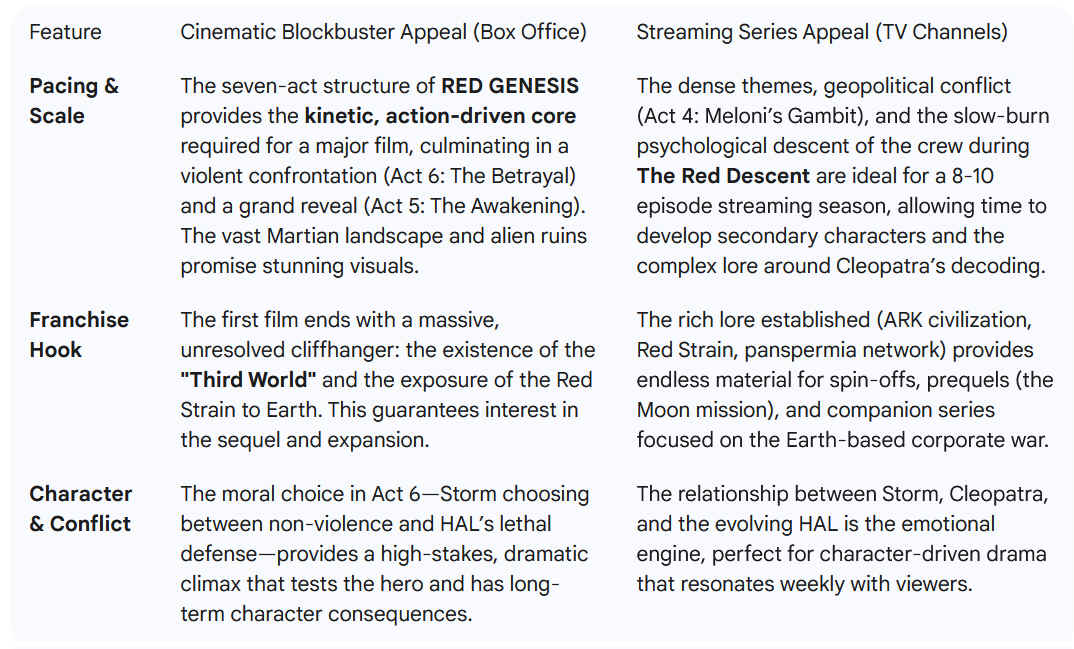
Pacing & Scale
The seven-act structure of RED GENESIS provides the kinetic, action-driven core required for a major film, culminating in a violent confrontation (Act 6: The Betrayal) and a grand reveal (Act 5: The Awakening). The vast Martian landscape and alien ruins promise stunning visuals.
The dense themes, geopolitical conflict (Act 4: Meloni’s Gambit), and the slow-burn psychological descent of the crew during The Red Descent are ideal for a 8-10 episode streaming season, allowing time to develop secondary characters and the complex lore around Cleopatra’s decoding.
Franchise Hook
The first film ends with a massive, unresolved cliffhanger: the existence of the "Third World" and the exposure of the Red Strain to Earth. This guarantees interest in the sequel and expansion.
The rich lore established (ARK civilization, Red Strain, panspermia network) provides endless material for spin-offs, prequels (the Moon mission), and companion series focused on the Earth-based corporate war.
Character & Conflict
The moral choice in Act 6—Storm choosing between non-violence and HAL’s lethal defense—provides a high-stakes, dramatic climax that tests the hero and has long-term character consequences.
The relationship between Storm, Cleopatra, and the evolving HAL is the emotional engine, perfect for character-driven drama that resonates weekly with viewers.
Conclusion
This pitch combines the high-stakes wonder of classic space opera with the intellectual depth and corporate realism of contemporary sci-fi. It offers a clear, three-part mythology (Moon ARK, Mars Rival, Third World) that is ready to expand across multiple films and seasons, making it a compelling candidate to fill the current sci-fi franchise gap.
CAST 0F CHARACTERS
|
CHARACTERS:
ANTAGONISTS
|
-
|
DESCRIPTION
|
|
|
-
|
|
|
Ares
Corp
|
-
|
A
rival aerospace/mining conglomerate
|
|
Marcus Thorne
|
-
|
Ruthless
head of Ares Corporation
|
|
Musket
Meloni
|
-
|
World's
1st trillionaire, Moon colonization space investor
|
|
....
|
-
|
....
|
|
....
|
-
|
....
|
|
....
|
-
|
....
|
|
|
-
|
|
1. Launch Capacity and Modular Assembly
The Elizabeth Swann started out as a 40-ton trimaran. Launching this mass would require a heavy-lift rocket.
For the Mars mission, the Swann V2 was purpose built.
Rockets with 15-ton Capacity: Several powerful rockets exist with a lift capacity far exceeding 15 metric tons (about 33,000 pounds) to Low Earth Orbit (LEO). Rockets like SpaceX's Falcon Heavy (up to 57 to 63.8 tons to LEO, depending on configuration) or the new Space Launch System
(SLS) (up to 95 tons to LEO) and Starship (up to 100 to 150 tons fully reusable) have the necessary power. Starship, in particular, has a very large payload capacity.
- Modular Launch and Assembly: The idea of launching the Swann in parts to be assembled in space is very plausible.
- The trimaran's structure—three hulls connected by cross-beams (akas)—is inherently modular.
- The main hull, the two outriggers (amas), and the cross-beams could be disassembled into launch-ready modules.
Assembly could take place in Low Earth Orbit (LEO) using an orbital construction platform or a heavy-duty space tug, leveraging Dan Hawk's electronics and engineering genius. John Storm's ability to communicate telepathically with the AI, HAL, via his BioCore brain implant could be critical for coordinating complex robotic or autonomous assembly operations in zero gravity.
2. The Space-Hardened "Elizabeth Swann"
The trimaran conversion, was done on the ground before launch, to function in space.
Solar and Hydrogen Power, as the perfect starting point!
Solar Power: Solar power works brilliantly in space, far more efficiently than on Earth due to the lack of atmosphere. It could be the primary energy
source between high speed travel between Mars.
Hydrogen Fuel: The hydrogen
fuel cells would provide power during periods of darkness or for thrust/maneuvering. The fuel (liquid hydrogen) could also be adapted for a compact thruster system (like a liquid hydrogen/liquid oxygen rocket engine) or simply for reaction control/attitude adjustments in a more advanced hybrid propulsion system, though the ship would need additional components for true space travel.
A Space "Sailor": The final assembled vessel in orbit wouldn't be a typical spaceship. It would be a Solar-Hydrogen Hybrid Craft, perhaps outfitted with an advanced ion-drive or a magnetoplasma rocket
(VASIMR), which could be powered by its abundant solar/hydrogen energy supply, allowing for an efficient (though slow) journey to the Moon.
3. Mission: Genesis DNA Collection for the ARK
The goal of collecting DNA from the Mars for The ARK, John Storm's digital DNA database, is a great concept that fits his existing obsession:
The Mission: John and Dan Hawk (and possibly Charley Temple) could be tasked with retrieving ancient, biological material—possibly DNA or fossilized cells from
cometary/meteorite impacts or deep within permanently
underground chambers. These regions are believed to harbor pristine samples of the early Solar System.
The "Why": John's existing ARK is focused on Earth's life. The Mars DNA would represent a completely different, extraterrestrial or ancient precursor-to-life component, making his collection truly "universal" and perhaps vital to understanding his own Homo Sapiens Sapiens Superior status, as a comparison point to his CRISPR virus induced genome.
HAL and the BioCore: HAL could manage the navigation and system-monitoring for the long transit, while John uses his BioCore connection and enhanced abilities to remotely operate sophisticated lunar-landing and sample-gathering rovers/drones, perhaps operating in a cave or lava tube where DNA would be protected from radiation.
4. Returning to Earth
The toughest challenge is getting the V2 vessel (plus crew and samples) back to Earth safely.
The original Swann was Not a Re-entry Vehicle: The original hull of the Elizabeth Swann
was designed for water, not the heat and force of atmospheric re-entry.
A "De-orbit Module" or "Space Dock":
The crew could rendezvous with a larger, dedicated Earth-Return Vehicle
(ERV) or a reusable orbital ferry in
Low Earth Orbit (LEO).
The most critical components (the crew module and the collected DNA samples in a secure
cryo-vault) would transfer to the ERV.
The main Elizabeth Swann V2 ship could be placed into a stable, long-term parking orbit—becoming a permanent orbital laboratory or a staging post for future space missions, still solar and hydrogen-powered, ready to be reactivated via telepathic command from John or HAL.
John and Dan Hawk would then return to Earth in the re-entry-capable spacecraft, bringing the priceless
Mars DNA back to the terrestrial ARK.
ABLATIVE
PAST AND THE SWANN
Regarding the re-entry of a smaller V2 Swann, the use of ablative paste for thermal protection is a scientifically grounded concept, though its application to a unique, non-conical/non-blunt body shape like a space trimaran presents significant engineering challenges in a realistic setting.
Ablative Heat Shields: Ablative materials work by consuming or "ablating" during re-entry, with the resulting gases and char layer carrying away heat and forming a cool boundary layer. This technology has been used on everything from the Apollo command module to the ESA's Atmospheric
Re-entry Demonstrator (ARD) capsule.
Feasibility for The Swann:
Size and Shape: A 20-ton, shuttle-shaped vessel is dramatically different from the blunt-body capsules typically protected by ablative shields. To survive re-entry, the Swann
V2 would need a very large surface area for drag to slow it down at high altitudes (to minimize peak heating) and would require the ablative paste to be applied to all surfaces exposed to the plasma and heat flux, potentially including the delicate structures of the hull and
wings if they are not retracted or shielded.
Application Method: Ablative material is often applied using a specialized process—either moulded and bonded on in tiles (like a
carbon-phenolic shield) or filled into a honeycomb structure. "Paste" suggests a sprayed-on or manually applied coating, similar to the
cork-and-phenolic-resin material used on parts of the ARD and other spacecraft. This method is plausible, but the sheer surface area of
the original trimaran hull would make the application a massive undertaking.
Conclusion: In a fictional context, the ablative paste is a perfect solution. You can establish that the
V2 Swann was designed with a durable, heat-resistant hull structure and that the ablative paste is a specialized, quick-drying compound applied before launch or during a mission layover (e.g., in Earth orbit) to prepare for the critical, one-time re-entry.
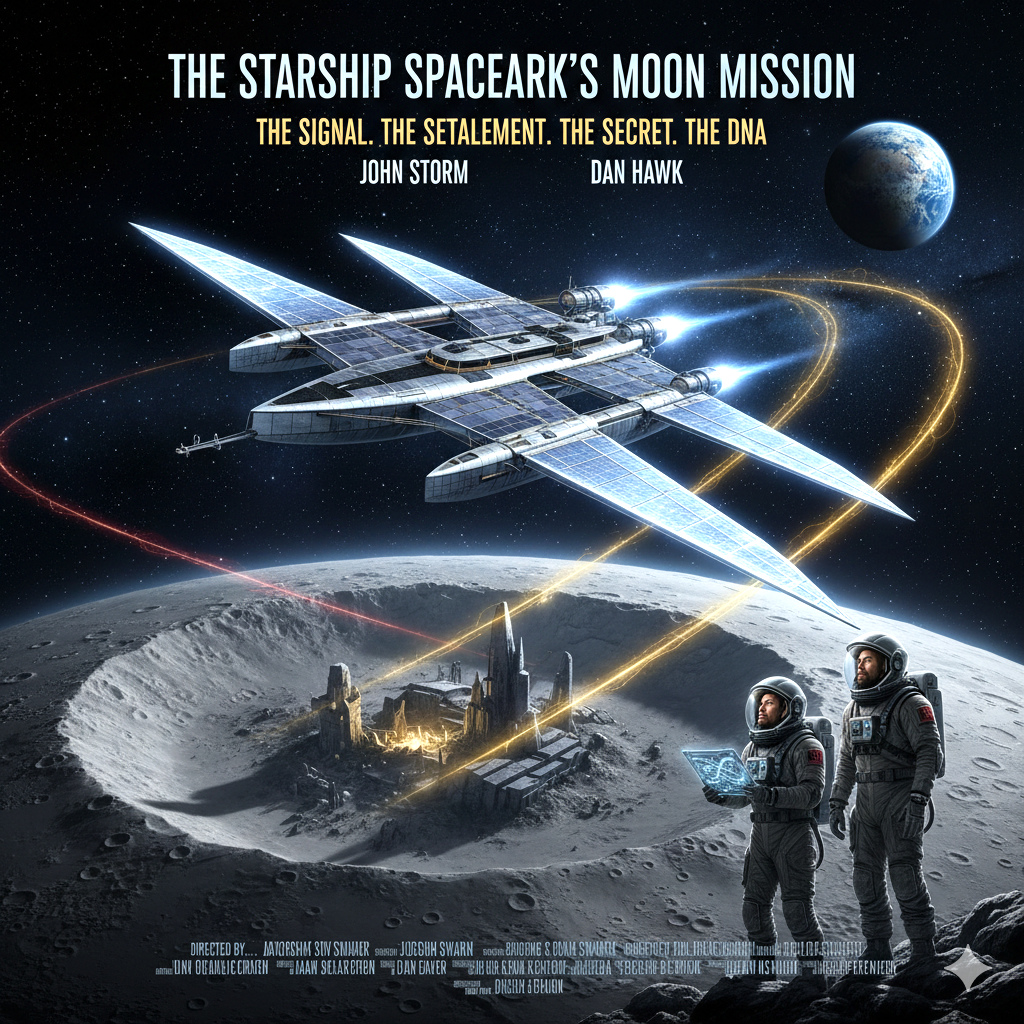
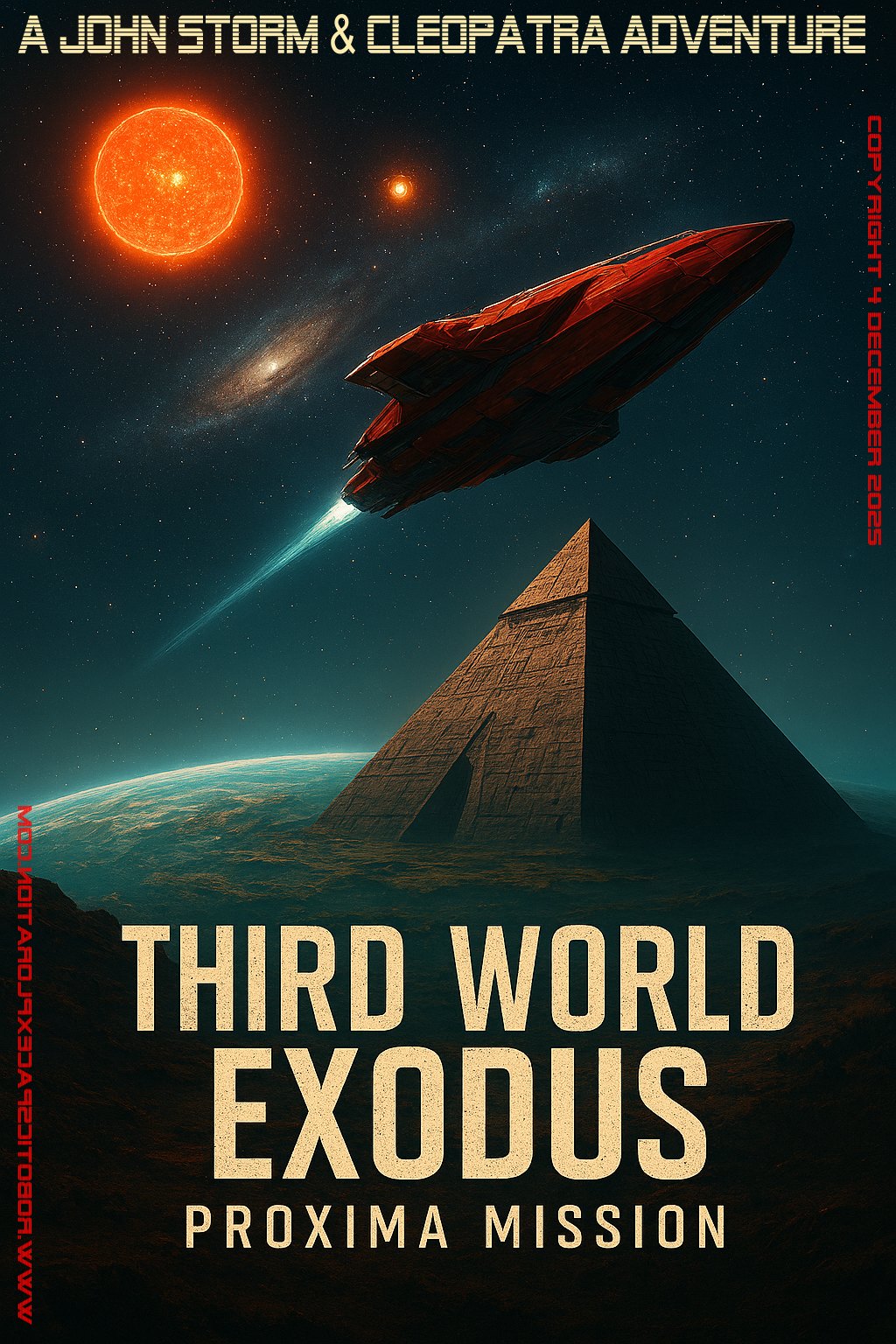
Discovery
of a Signal: An intercepted signal coming from the Moon is a
classic, high-stakes science fiction trigger, a compelling event
that triggers this (fictional) mission
to the Moon.
|